


By Erin Judge, managing editor, PostPress
It’s hard to imagine a time when artificial intelligence (AI) only existed in science fiction novels and movies. Today, with the rise of open AI platforms and smartphone integration, the technology has become woven into nearly every aspect of daily life.

While some fear AI will replace human jobs, others argue it will instead make roles more efficient and effective. Friend or foe – AI is here to stay; and most predict, it will reinvent the workforce. PostPress spoke with several manufacturers in the finishing and embellishment space to see how AI is set to impact the industry – and how, in some cases, it already has.
The Complexities of AI in Printing Today
Best suited for repetitive, data-driven tasks, AI can be more difficult to implement in print production than in many other industries. “Printing involves highly variable jobs and personalized products,” said Raquel Caruso, marketing manager at Müller Martini. “This requires systems that not only plan but also react in real time. While other sectors rely on stable series production, print depends on adaptive control and inspection.”
Despite those challenges, printers are finding practical applications for AI today – from customer communications and estimating to prepress and workflow automation – improving job scheduling and ganging to reduce paper waste and increase margins. “The print industry stands out for fast customization, using AI to manage thousands of unique, personalized details – turning operational complexity into a competitive advantage rather than a limitation,” said Adee Mor, chief marketing officer at Scodix.
That variability ultimately makes print a strong candidate for AI, commented Sean Roberts, national director of digital embellishment at Konica Minolta. “AI brings standardization to a process that is otherwise highly customized.” In estimating, AI can use weighted inputs such as materials, run length, complexity and market data to deliver accurate pricing in seconds. With each job, the system continues to learn, becoming more accurate over time.
AI is also highly effective at analyzing production data and automating the documentation of standard workflows. Its real-time insights minimize manual effort, enabling employees to spend less time on “number-crunching” and more on problem-solving and innovation.
Importantly, those insights are 100% objective and data-driven, commented Chris Raney, vice president of postpress product management at Heidelberg USA. “Too often, management decisions today are influenced by the subjective observations of a single operator.”
“AI shifts decision-making from reactive to predictive,” said Roberts. “It can instantly model multiple scenarios – rescheduling jobs, reallocating labor, adjusting throughput or optimizing estimates based on market and demographic inputs.”
Where Does AI Fit into Embellishing and Finishing?
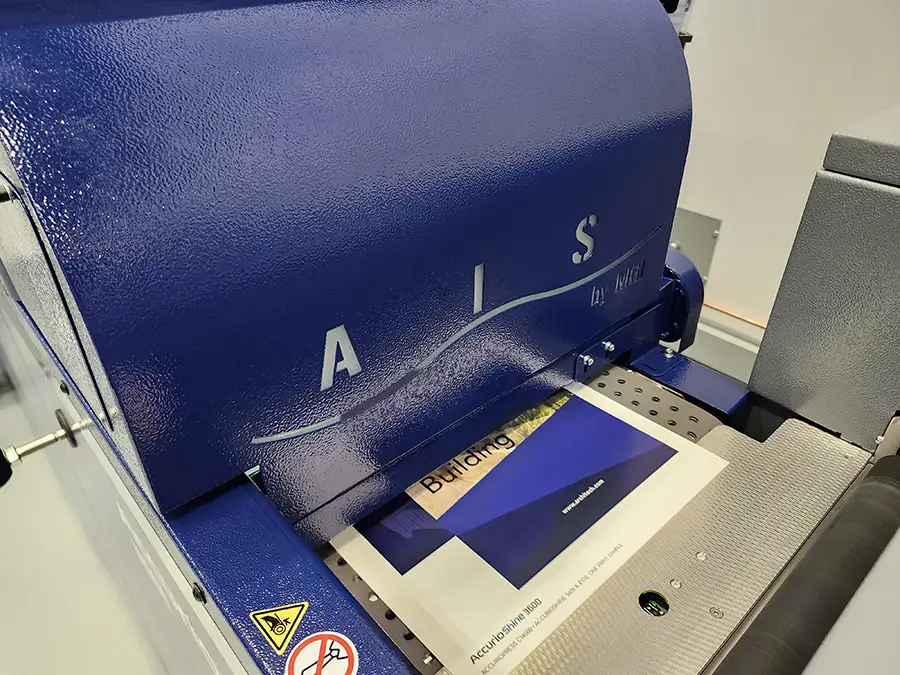
In embellishing specifically, AI is already making significant advancements streamlining workflows for both designers and prepress operators. AI-enabled software can analyze design files and automatically make suggestions for the best areas to add embellishments, including coatings and foils – even automating the creation of layers and masks within these files. This not only cuts the time required in prepress to edit designer files but also minimizes production re-runs caused by errors in file preparation.
Taking it a step further, by combining historical production data with material behavior modeling, AI visualization delivers accurate 3D digital renderings that allow designers and prepress managers to evaluate effects prior to prototyping or production.
“During the design phase, designers can now visualize exactly how different materials – coatings, foils, substrates – will interact in real-world applications,” said Mor. “This removes the need for trial and error, so they can spend more time on creative ideas instead of technical tweaks – confidently planning premium embellishment from the outset.”
He added that as the technology becomes more widely available, it will reduce the complexity surrounding tactile effects such as raised varnish, foil and holographic textures – driving broader adoption of these embellishments among designers and brands.
Downstream, the software improves production efficiency by preventing last-minute material changes. This significantly cuts costly substrate and foil waste, lowers energy consumption and reduces machine downtime. “Worldwide, even a 1% reduction in waste or a 5% decrease in energy use can deliver meaningful environmental and financial gains,” Mor noted.
Errors and waste are further eliminated with the help of AI-driven inspection systems, which can detect deviations in registration, coating density or color accuracy instantly during production and recommend corrective action and/or automatically fix them. “While detection has existed for years,” said Roberts, “the real advancement is decision automation. Instead of stopping a run and troubleshooting mid-stream, AI can guide corrections in real time, improving consistency and reducing operator burden. Changeovers become faster, cleaner and far more predictable.”
At the same time, an increasing number of manufacturers are rolling out AI-driven predictive monitoring, alerting management to potential machine issues before failures occur – reducing costly downtime and enabling proactive maintenance.
While traditional processes like diecutting, folding and binding are currently less suited for direct AI control due to their dependence on mechanical set-ups, Raney believes AI provides opportunity to deliver measurable value. “AI can leverage knowledge from similar production runs to optimize folding schemes and machine settings,” he said. “It can also provide realistic production targets that enable users to more accurately calculate costs, helping maximize revenue and margins.”
AI can further support finishing operations by addressing unexpected variables, including fluctuations in substrate quality. “Variability represents a significant opportunity for AI,” said Caruso. “By analyzing environmental and material data, AI can enable adaptive controls that compensate for these fluctuations and help ensure consistent quality.”
Roberts added that with the right inputs – like substrate specifications, chemistry and equipment profiles – AI can also predict outcomes such as fold cracking, mail durability and gloss performance after handling.
The Human Element
Already beginning to appear in select production environments, AI is expected in the near future to autonomously power “smart,” connected print and finishing systems – seamlessly moving jobs from prepress to printing to cutting to foiling without manual data entry. Caruso expects these platforms to deliver real-time quality assurance, dynamic production planning and automated reporting. “Smart postpress will incorporate predictive maintenance, set-up recommendations and context-based operator guidance,” she said.
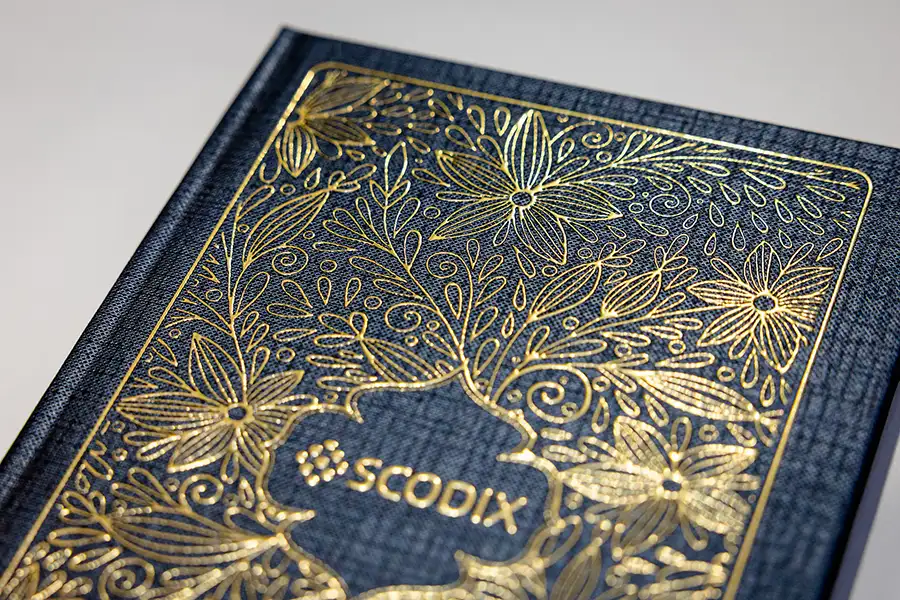
Raney added, “Smart finishing of the future will be driven by data – set-up times, production speed targets, etc. By establishing these benchmarks, costing becomes more accurate, enabling operators to align production and protect customer profitability.”
Despite AI’s rapid advancement, industry leaders agree it will not eliminate the need for human expertise in production. Instead, AI is expected to simplify day-to-day operations by automating routine tasks, reducing manual checks, lowering waste and supporting scheduled maintenance. As Roberts summarized, “The future isn’t automated finishing – it’s augmented finishing. These systems don’t replace people; they amplify them.”
Certain human skills will become increasingly critical as AI moves deeper into production environments. Problem-solving and critical thinking become paramount as “automation only works when everything responds as expected,” commented Raney. “What seems sound in theory, does not always translate into reality. When something goes wrong, you will need the operator’s expertise to correct the problem. AI can never replace fundamental operator knowledge and skill.” Additionally, requirements for data literacy, process understanding and the ability to interact with intelligent assistance systems will continue to increase.
“Human expertise is still crucial for quality control,” said Mor. “Professionals will always be needed for detailed visual choices, telling the brand’s story and ensuring the creative vision comes through in the final product.”
Human skill will also remain essential as challenges in the manufacturing environment can inherently pose challenges for AI. Physical factors such as humidity, ink tension and the mechanical and electrical condition of the machine can interfere with AI automation, which relies on high data availability and clear quality criteria. “As an organic material, paper reacts sensitively to temperature, air pressure and humidity – making automation complex,” said Caruso. Additionally, AI recommendations can be compromised if inspection-system sensors are dirty or not properly maintained.
Outside of physical elements, the biggest barriers to AI adoption are organizational. “AI adoption fails when there’s no strategy, ownership or willingness to change behavior,” said Roberts. “Successful adoption requires leadership, clean data practices and a culture that encourages experimentation while moving quickly toward standardization.”
Caruso added, “The adoption of AI in postpress is mainly hindered by a lack of standards, integration issues and the quality of available data. Without a reliable data foundation and open interfaces, learning systems cannot reach their full potential.”
Removing Friction, Not Craftsman
As AI adoption accelerates in the industry, a study by PRINTING United Alliance surveying over 300 companies across commercial printing, sign and graphics, book manufacturing and apparel decoration shows that 85% view AI as essential for competitiveness, and 83% see it opening new opportunities. The findings highlight the urgent need for rapid education and integration at all levels – helping the industry move past fear and uncertainty around this emerging technology.
“AI is not about removing craftsmanship but removing friction,” concluded Roberts. “Its biggest impact will be predictability: Fewer surprises, faster turnaround and more confidence selling premium embellishment effects at scale.”
Mor added, “AI cannot replace a designer’s skill in creating a brand’s unique ‘soul.’ Human creativity, emotional impact and strategic judgment will remain essential to producing high-quality work.”