


By Mathieu Tremblay, managing director, IMPACK, Canada
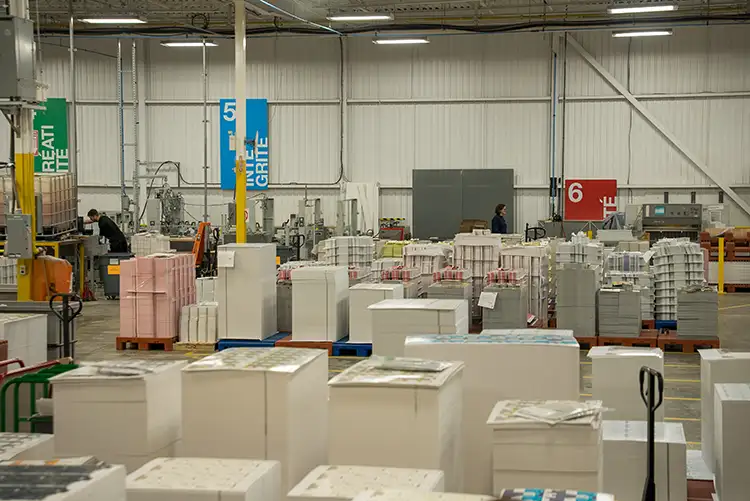
On a printing press or diecutter, a sheet is a sheet. It comes in a predictable, consistent size. It flows through the process the same way every time, but once the blank gets to the folder-gluer, variability exponentially increases. Each box type is processed differently, and each presents its own challenges.
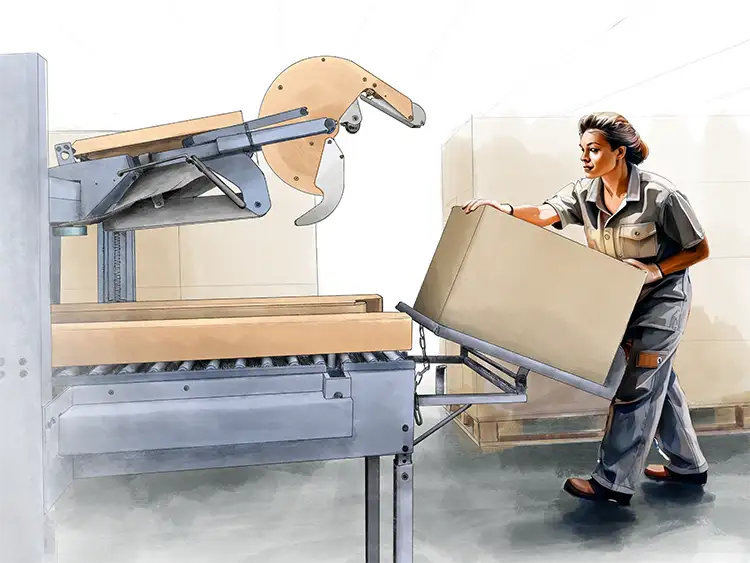
Historically, human adaptability has played a key role in managing variability in the folding-gluing process. But in the current labor context, these job positions are becoming increasingly harder to fill. Repetitive tasks, especially with heavy products, introduce safety issues and increase the risk of repetitive strain injuries. Understandably, people aren’t eager to do physically demanding work. Additionally, humans have natural speed limitations, which cap capacity on the line.
Unlike printing and diecutting, which are largely automated, the end-of-line in the finishing department is still highly manual and the most complex to automate. The good news is that “smart automation” in the finishing department, especially end-of-line, eliminates heavy lifting – unlocking maximum speed and capacity.
Why Smart Automation?
Automation in the finishing department is a journey that requires careful planning and preparation long before equipment is selected or installed. Many automation projects struggle – not because of the technology itself, but because the underlying processes, data and organizational readiness weren’t fully considered from the start. Smart automationstarts with understanding constraints, aligning people and processes and making informed decisions before investing in technology. Taking time to properly lay the groundwork allows manufacturers to move forward with clarity and realistic expectations. This sets the stage for improvements that actually deliver value.
This article explores how to prepare for that journey by focusing on system readiness, process stability and people as much as machines. Rather than chasing maximum automation, smart automation emphasizes organizational readiness, understanding production realities and building a strong data-driven business case. By establishing this foundation, businesses can make smarter decisions about where automation will have the greatest impact today, while positioning themselves for more advanced solutions tomorrow.
Laying the Groundwork

Smart automation often starts by analyzing the system and pinpointing the greatest bottleneck that’s limiting the speed of the process. Solving one bottleneck often reveals the next greatest bottleneck. As each step in the process becomes automated, safety, efficiency and capacity all increase.
Automation is as much about people and processes as it is about machines. It’s a gradual shift that involves technical adaptation and human transformation. Every automated task affects a web of connected processes – from machine set-up and production planning to staffing, metrics and even the way success is defined.
What Companies Must Consider
Here are five key areas that affect the success of automation projects in complex manufacturing environments:
- System Integration:
Do current ERP and MES systems communicate with the automation hardware? Are workflows digitized, or will this create data silos? - Process Readiness:
Are current process standardized and repeatable? - Organizational Readiness:
Are teams trained and supported for this change? Has change management been planned? Are there internal “automation champions”? - Flexibility vs. Throughput:
How much operational variation is required? Semi-automation excels in high-mix, frequent changeover environments, while full automation favors long, stable runs. - Total Cost of Ownership (TCO):
Look beyond the purchase price: Consider installation, training, safety compliance and maintenance as well as expected uptime and increase in capacity. Additionally, review the impact this will have on staffing.
Planning the Journey
The first step in any automation journey should be a thorough process map. Working through the automation journey, the objective is to progressively improve it. This will require working toward major process transformation milestones. As automation increases, it doesn’t just change equipment – it reshapes how the operation functions day to day:
- Machine set-up and changeover
- Crew roles and skill requirements
- Scheduling of people and products
- Quality control
- KPIs and performance evaluation
To manage the logistics of the transformation, data is required at every step. The initial collected data becomes the foundation for a solid business case for automation. While automation projects can appear costly at first glance, many manufacturers discover that payback is achieved far sooner than expected once all variables are considered. Data is also required to assess various automation solutions.
To accurately assess return on investment, analyze current production using the following factors:
- Production Volume (grouped by similar box types of similar sizes)
- Number of boxes per run
- Number of runs per week or month
- Downtime
- Due to makereadies
- Linked to labor instability
- Due to preventative and unplanned maintenance
- Total Labor Cost on the Finishing Line
- Crew
- Number of shifts
While automating physical tasks with AI is still a long way off, AI already plays a valuable role in planning and scheduling. Most finishing department managers do their best to consolidate box types on specialized folder-gluers – reducing downtime related to makereadies. Last-minute orders, fluctuating orders and staff availability can disrupt even the best-laid plans. AI can be used to analyze large data sets to reveal patterns that support smarter decisions – both operationally and financially.
Start the Automation Journey
Smart automation is not about pursuing the highest level of automation possible – it’s about making informed decisions that improve safety, stability and performance where they matter most. In complex environments, success depends on aligning technology with real production needs, workforce realities and long-term operational goals.
Mathieu Tremblay is the managing director of IMPACK, an engineering-driven company specializing in peripheral automation for packaging producers. With a background in electrical engineering and automation, his insights are anchored in hands-on expertise in automated system design. His over 20 years of experience at IMPACK make him a trusted advisor for pragmatic smart automation. For more information, visit www.impack.ca
Footnote: Photography by Jennyfer Monette, artwork by Dmytro Zhurov, copyright Conception IMPACK 2025