


By Dianna Brodine, vice president, editorial, PostPress
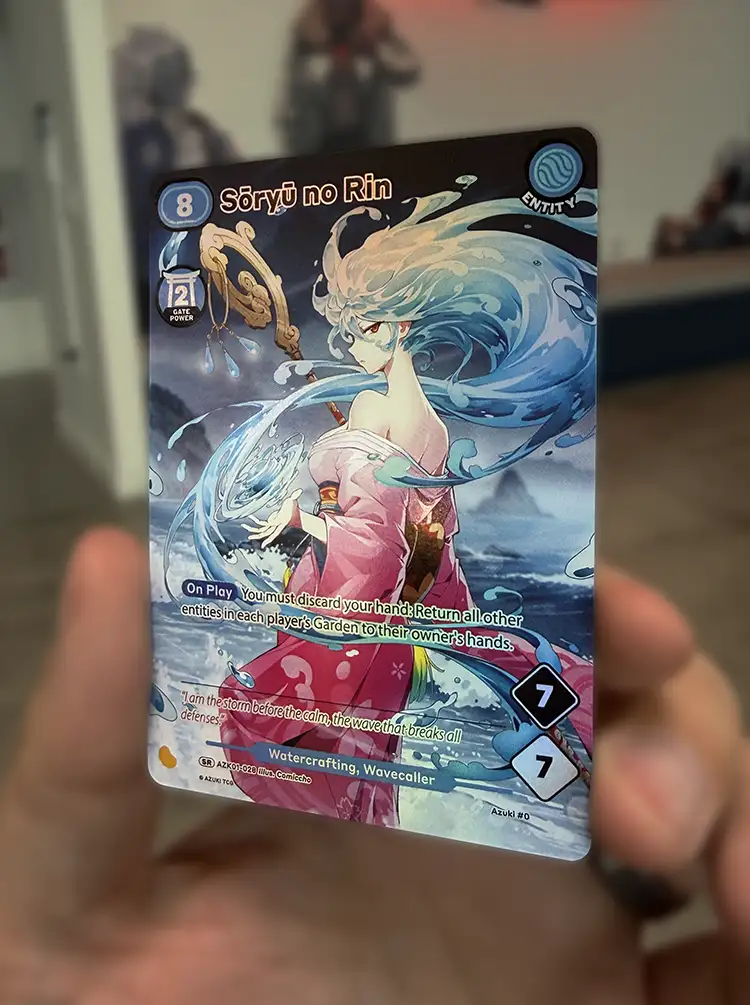
If there’s any question about the trajectory of the global trading card market, a look at recent trading card headlines should put doubts to rest:
- Are collectibles a viable asset class? The buyer of the $16.5 million Pokémon card thinks so (CNBC)
- Why Pokémon cards are growing faster than your retirement account (NPR)
- Japan weighs regulating Pokémon cards amid trading mania (Bloomberg)
- Gotta collect ‘em all: Trading card market could be worth up to $20 billion (Yahoo Finance)
- Trading Cards are Winning Wallets: RRD Study Shows What Drives Collector Investments (Business Wire)
The report referenced in that final headline, RRD’s 2026 Collectibles and Trading Card Report, found that 31% of respondents said their collections are worth more than their savings accounts, nearly 40% have prioritized a collectible purchase over paying for bills or house repairs, and 27% said investment potential was their primary driver for purchase.
Of interest to the PostPress audience are the statistics on what drives collectors’ overall satisfaction with a new purchase: Artwork Quality and Aesthetic Appeal (84%); Texture, Foil or Holographic Effects (77%); and Durability and Resistance to Damage (72%). In other words, print embellishments are driving value in the minds of consumers.
To share more information on these global trends, PostPress reached out to Corey Lewis (Azuki) and Stefan Congram (Cartamundi). Lewis is the head of global print production, where he handles all of Azuki’s print but most crucially the Trading Card Games (TCGs). Previously, he had his own firm – Card Juice – where he freelanced for five startup companies and helped produce and bring their cards to market. Lewis also worked at The Pokémon Company International from March 2020 through May 2024 as the manager of global print production.
Congram is a product development and manufacturing leader with more than 20 years of experience in technical printing, packaging, product design and print embellishments. He leads global product development operations, spanning product strategy, design, prepress, manufacturing and supply chain. Congram has spent over a decade partnering with leading studios and global brands – including Wizards of the Coast, Hasbro, Mattel, Asmodee, Ravensburger, Pokémon, Bandai and Yu-Gi-Oh!.
What factors are driving growth in the global trading card market?
Lewis: I think the answer to that question is as fascinating as it is multi-faceted. To some, trading cards and collectibles have a financial value. They perceive a loss of trust in traditional institutions like Wall Street and turn instead to alternative, tangible assets they can own and store. It’s not that different from people who buy, sell and trade other physical items, like sneakers. One friend recently told me, “I don’t buy stocks, bonds or ETFs. I only buy Pokémon.”
It’s also impossible to overstate digital fatigue in modern consumer preference. People have had enough of AI and screens, so they place their value in tangible artwork. Another factor that can’t be overlooked is nostalgia. What was previously restricted to geekdom is now in the mainstream. The trend forecasting agency WGSN identified nostalgia “as a primary consumer mindset driven by the ‘Kidult’ economy and the ‘Forever Young Adult’ demographic. Seeking comfort from global uncertainties and stress, consumers are turning to brands, toys and multisensory experiences that evoke joy and provide escapism from adult responsibilities.”
Finally, we can’t forget that many collectibles are games, such as Yu-Gi-Oh, Magic: The Gathering, One Piece and many more. In the post-pandemic world, people are through with staying at home. Trading card games (TCGs) provide a sense of community for people to come together in person at their local game store and play a friendly game.
Congram: The short answer? This market found three things simultaneously that almost never happen at the same time: A massive new audience, a new asset class and a post-pandemic reset of how people think about tangible, physical objects.
First, demographics: The generation that grew up cracking Pokémon packs in the late 1990s and early 2000s now is in its late 20s and 30s – and the members of that generation have disposable income and serious nostalgia. When Logan Paul wore a Pikachu Illustrator card worth over $5 million (it recently sold for much more) around his neck to a boxing match, it didn’t just go viral – it told an entire generation that the cards they traded as kids were now legitimate assets.
Second, the investment story changed. Traditional alternative assets – art, wine, watches – always have had a wealthy collector audience. Trading cards democratized that. A collector could start with $20 and still have a shot at pulling something worth thousands. Platforms like Professional Sports Authenticator (PSA) brought grading infrastructure that gave cards a standardized, trusted valuation. Once someone can grade and vault an asset, institutional money starts paying attention.
Third, gaming TCGs exploded. It’s not just sports anymore. Pokémon, Magic: The Gathering, One Piece, Disney Lorcana, Yu-Gi-Oh – these franchises have built global player communities of active competitors who also happen to collect. When a card has tournament playability AND rarity AND beautiful embellishment, its value is being driven by multiple audiences simultaneously. That multi-driver demand is incredibly powerful. And underneath all of it is the physical premium. In a world saturated with digital content, people are actively seeking out things they can hold, display and feel. That tactile, experiential quality is the secret weapon of this entire market.

Both of you work within the gaming trading card area. What market challenges are there when creating trading cards for gaming customers rather than sports card enthusiasts?
Lewis: In my opinion, TCGs have a huge advantage over regular collectible cards. If you’re collecting baseball cards and ripping a lot of packs, what are you supposed to do with the 17 Nick Madrigal cards you pulled? (Sorry, Nick Madrigal.) I guess you just keep them, stash them in a binder somewhere or throw them out. With TCGs, multiple card copies have game utility. You want multiple copies of that “Twisted Vines” card if you’re running a certain build.
But the tradeoff with that is the cards need to be functionally identical when produced. The special foil card can’t be heavier, more textured or otherwise discernable in a blind setting or players can use that to obtain an unfair advantage. TCG cards also need to be engineered to more precise specifications for glide, snap and shuffle.
Congram: A sports card collector asks, “Who is this player, and what have they done?” A gaming collector asks, “What is this card, what can it do in the game and how rare is it?” Those are completely different value frameworks – and they require completely different production strategies.
Gaming customers are far more technically demanding when it comes to embellishment. The gaming community is extremely sophisticated. Collectors can tell the difference between a standard foil pattern and an etched foil pattern at a glance. They’ll spot a mismatch in a holographic treatment from 10 feet away. They discuss these details obsessively online. That means there’s almost no room to cut corners – and a lot of room to add value by doing something genuinely special.
The challenge is that innovation creates expectation. Once Pokémon introduced the Chaos Holo texture in its Mega Evolution sets, suddenly that became the new baseline for what premium looks like. Gaming publishers are in a constant arms race to deliver the next wow effect – which is great news for the embellishment industry, but it means our job is never finished.
What is the role of embellishment as it relates to collectability and value creation in the trading card space?
Lewis: When we use embellishments on Azuki cards, we retain the more brilliant, high-value embellishments on the rarest cards. That way we can immediately signal to the consumer when they pull it out of the pack they’ve obtained something truly special.
We look for embellishments that accentuate our awesome artwork without overpowering it. Due to that demand, along with the need to keep up in a competitive industry, we consider, test and source all types of embellishments. These include cast & cure, cold foil, hot foil, digital embellishment applications, laminated foil and more. We often use them in tandem on the same piece to achieve a desired outcome.
For cards, time after time we return to the world of full-coverage laminated foil. It provides the highest level of brilliance we need, although we utilize opaque white to let the shine come through where we want it.
Congram: Embellishment isn’t a decoration in this market. It’s the product. That’s a sentence I’d love every print buyer and procurement manager to read, because it completely flips the conventional cost-vs.-value equation.
In traditional commercial print, embellishment often is treated as an add-on – something you either justify or cut depending on budget. In the trading card world, embellishment often is the primary reason a card commands a premium price. The base version of a card might be worth $2. The Special Illustration Rare version of the same character, printed on the same stock, with textured etched foil and holographic treatment applied to the artwork? That card might sell for $400 at retail and $800 on the secondary market. The embellishment created $798 of that value.
As Scodix’s April Lytle put it during a recent industry discussion: Texture can create realism, raised varnish can simulate armor or fabric, metallic effects add dimensional depth, and specialty foils can evoke energy and movement. In the best modern card designs, embellishment is integrated directly into the creative concept from the beginning – not applied as an afterthought. The designer and the embellishment specialist are collaborating before a single line of art is drawn. That creative integration represents a huge maturation of the market. And it has implications far beyond trading cards – it’s showing the broader print industry what’s possible when embellishment is treated as a core value driver rather than a cost line.
How is counterfeiting impacting profitability? And how is print embellishment being used to address that problem?
Lewis: Every day, fake cards get more and more convincing. Grading companies that are employed to authenticate cards are overwhelmed with a backlog, so certain fakes are being graded and slabbed as well. The potential for profit is huge if a counterfeiter can get a decent at-home printer and some stock, and start passing off fake cards.
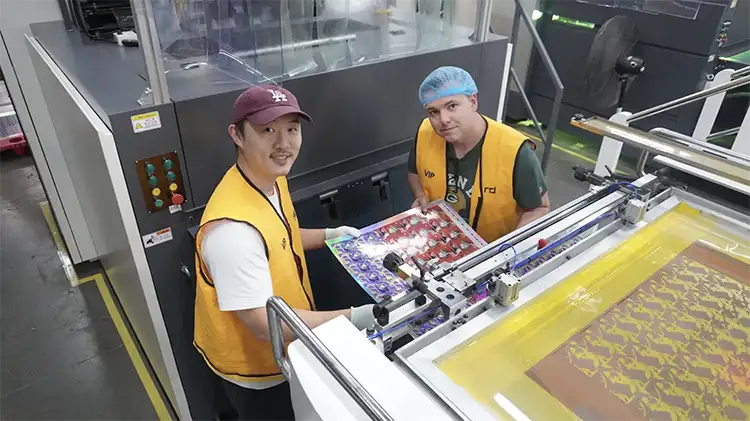
Anti-counterfeiting is a huge gap in the industry and something I wish more brands would take seriously. The technology to implement certainly is there – hidden marks, invisible inks, watermarking. In my experience the big brands are reticent to implement these measures for cost reasons.
Congram: This is the question that keeps publishers, retailers and collectors up at night – and the numbers are genuinely alarming. PSA intercepted over $200 million in projected market value of fraudulent collectibles in 2025 – and that’s just what they caught. Even more striking: Pokémon card counterfeiting jumped 125% between 2024 and 2025. The technology available to counterfeiters has improved dramatically – some modern fakes now pass casual visual inspection, and the sophistication of cloned grading slabs (complete with fake QR codes linking to replicated authentication websites) means the deception has moved from the card itself to the entire authentication ecosystem.
The financial damage extends well beyond lost sales. Counterfeiters that flood the secondary market with convincing fakes erode consumer trust in the entire ecosystem. Once a collector gets burned buying a fake, they become skeptical of every card they purchase. That skepticism suppresses the whole market. It’s an existential threat to an industry built on perceived value and authenticity.
Here’s where it gets interesting for those of us in the embellishment world: The solution increasingly is being found in the same technologies used to protect currencies and passports. A card with a custom, layered holographic treatment, embedded microtext and a unique serialized optical identifier is simultaneously more desirable to a collector and exponentially harder for a counterfeiter to reproduce.
KURZ has developed security foils that create color-shifting visuals, microtext and hidden images – optical effects so complex that they are essentially impossible to replicate without access to the original production equipment and specifications. The company’s proprietary SCRIBOS technology adds unique, copy-proof QR codes and digital IDs to each card or package, enabling item-level authentication via smartphone.
Breit Technologies brings Cast and Cure™ holographic processes that can embed custom micro-optical patterns – including patterns too small to see with the naked eye. ‘If counterfeiters don’t know it’s there, they can’t replicate it,’ as Tim Cain, Breit’s president, has noted.
Nanografix has developed NanoCast, which generates a unique optical identifier for every single package or card directly on the production line – encrypted photonic data that can be instantly authenticated via smartphone. No two units are ever the same. Copy one, and you’ve only copied one. Scale that to millions of counterfeit units, and you’ve failed.
Has interest in trading cards sparked growth in other gaming-related areas?
Lewis: Our other verticals are growing because of our TCG. We’ve done a number of licensed projects in apparel, and because of the TCG we push our vendors to hit a higher and higher quality standard, whether it’s direct to garment printing or dye sublimation. When we do packaging, our manga and other drops – customers now expect for those materials to be highly embellished because of their experience with our cards.
Congram: The TCG boom has been essentially a masterclass in proving that consumers will pay a significant premium for physical products that feel exceptional. That lesson hasn’t been lost on adjacent categories.
Board games are the most obvious beneficiary. The global board game market was valued at $15.9 billion in 2025 and is expected to nearly double to $35.4 billion by 2034. A big part of that growth is premium positioning. Publishers now are treating their box art, rulebooks, card decks and player components with the same reverence that previously was reserved for luxury packaging: Gold foil stamping on rulebook covers. Etched holo treatments on card decks. Textured, spot-UV-treated game boards. If it exists in a premium TCG context, somebody in the board game world is experimenting with applying it to their product.
Dungeon and Dragon sourcebooks and game manuals – products that used to be purely functional – are now being released as collector editions with foil stamped covers, special bindings and embossed detailing that justify $150 to $300 price tags for what is essentially a rulebook. That’s the TCG mindset migrating into tabletop RPGs.
Marketing collateral is another area seeing real investment. If you’re marketing to a collector audience that is hyper-sensitive to quality signals, your brochure, your booth materials and your product catalog cannot look like commodity print. Publishers exhibiting at conventions like Gen Con or PAX know that a matte-laminated brochure with spot UV and foil detailing communicates something very different than a standard folded sheet. It says: We take our product seriously. That quality signal cascades into how they’re perceived.
What do you predict for the future of trading cards market?
Lewis: It will continue to grow in the foreseeable future. There’s no end in sight that we can see, and the people who have predicted a market collapse have been astounded by more and more record-breaking sales years in the category.
As more brands enter the TCG space, they will work to differentiate themselves from their competition. That will mean more choices in foil color; more combinations of different effects together, such as cold foil and cast and cure; more personalization by relying on digital embellishments, such as Scodix; and more customization.
These new brands are entering a capacity-constrained environment, where the vast majority of established card printers are booked with other large programs. We will need all the bright minds in printing and embellishment to meet the future demand!
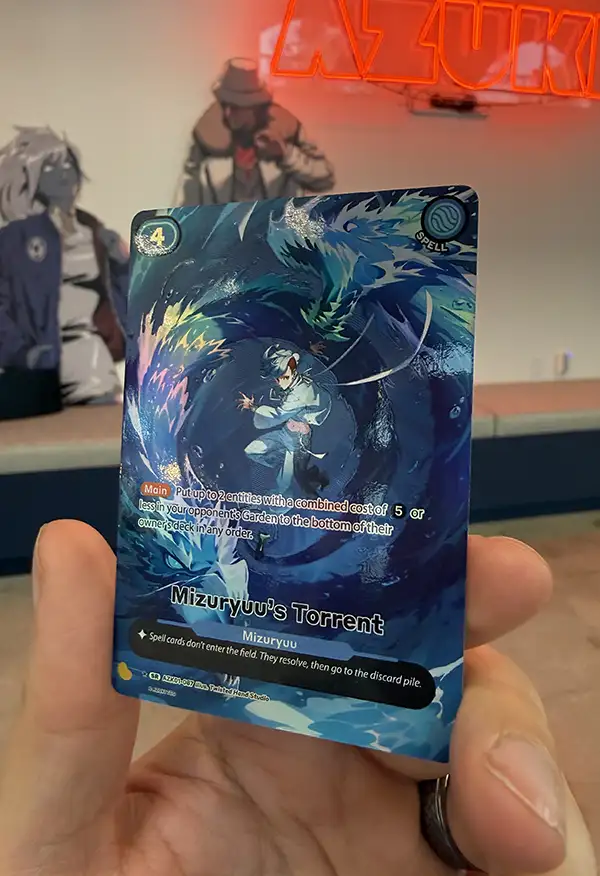
Congram: I think we’re still in early innings here, and the next five years are going to be genuinely wild.
The most significant macro shift is the phygital evolution – the convergence of physical cards with digital authentication, ownership records and interactivity. Altered TCG launched as the first true “phygital” trading card game, where physical cards have digital counterparts stored on-chain. The technology exists to embed NFC chips directly into cards, enabling real-time digital interactions, unlockable content and augmented reality features when scanned with a smartphone. That’s not science fiction – it’s already in market testing.
What this means for embellishment is fascinating. An NFC chip embedded in a card could be leveraged as a functional component, but it also creates new design space. The antenna and chip footprint can be integrated into the artwork – a glowing orb, a magical seal, a circuit pattern that serves double duty as both visual element and functional technology. The embellishment wraps the technology, making it beautiful and concealing it from counterfeiters who might try to harvest and reuse it. On the security side, I expect currency-grade holography to become standard rather than exceptional for premium card tiers.
Variable data embellishment is another frontier I’m excited about. The ability to print unique foil patterns, personalized holographic elements or one-of-one texture treatments on a digital embellishment press means that every card in a limited run could theoretically be distinct. That’s the kind of collector frenzy that publishers dream about, and the technology to execute it exists today.
For the gaming market specifically, I think the next category to watch is creator-driven drops. We’re seeing influencers and artists launch their own card IP’s – limited runs, direct-to-consumer, with production values that rival major publishers. Those creators are going to demand digital embellishment options that make their products look extraordinary on a fraction of the set-up cost that traditional analog finishing requires.
The broader theme, though, is this: Physical print is going to win the next decade by being irreplaceable, not by being cheaper. Trading cards figured that out before most of the print industry did. They built products so tactilely compelling, so visually stunning, so emotionally charged that people will pay $500 for two and a half inches of cardstock without blinking. That’s not magic – it’s the power of embellishment, executed with intent. The future belongs to printers and finishers who understand that they’re not in the ink-on-paper business. They’re in the experience business.