


By Jeff Peterson, editor-in-chief, PostPress
Specialty embellishments, including metallic decoration, spot UV coating and laminates, continue to grow across all types of printed materials, from roll-to-roll labels and folding cartons to flexible packaging. These enhancements help products stand out on retail shelves and create a sense of value and quality in the consumer’s eyes, including those purchasing through e-commerce channels.
Along with this growth, the techniques and processes to produce print embellishments for roll-to-roll applications also have expanded – from hot foil stamping/embossing and cold foil transfer to Cast and Cure embellishment processes and new digital embellishment technologies.
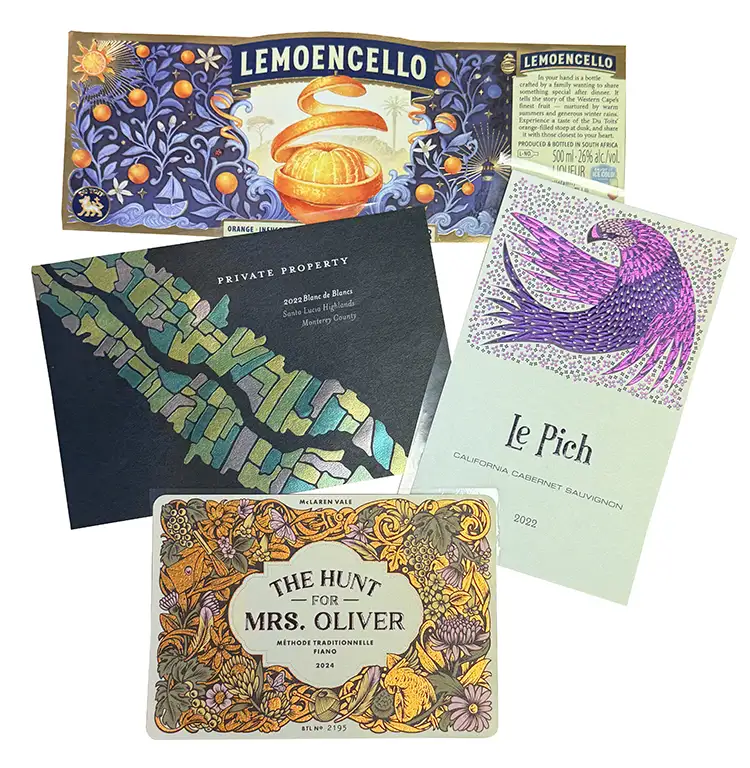
Hot Foil Stamping/Embossing
The most conventional way to apply a metallic foil embellishment to a label or carton is through hot foil stamping. The foil can be applied inline on a flexographic press utilizing a brass engraved rotary die or offline roll-to-roll with a stand-alone unit that utilizes flat engraved dies. Additionally, a label or carton can be embossed inline with a rotary male and female die, which allows printed labels or cartons to be printed, foil stamped and embossed all in one pass on an advanced inline flexo press with specialized modular stations.
“The advantage of applying hot foil inline on a flexographic printing press is having the ability to print and foil stamp in the one pass, reducing handling time and increasing throughput,” commented David Bales, technical sales for Univacco Technologies – supplier of hot, cold and digital foil products. “Since the foil and print are applied in the same continuous process, alignment is precise, minimizing misregistration issues.”
“Hot foil stamping is preferred over other processes when using an uncoated stock,” stated Ross Hutchison, national sales manager of Infinity® Foils, Inc. – supplier of hot, cold and digital foils. “If a specific foil color is required by a brand owner, then hot foil is ideal to achieve that exact color.”
“Wine and spirits labels are well suited for hot stamp applications,” explained Gary Biber, director of new creative business at K Laser Technology – supplier of cold and digital foils. “The process allows for sharp clean edges on all types of label substrates.”
The disadvantage of hot foil stamping is the upfront costs of the tooling and set-up time, especially with inline applications using a rotary die. This relegates inline hot foil stamping to longer runs where the cost of the dies and set-up is justified.
Cold Foil Transfer
In addition to hot foil stamping, many metallic decorated roll-to-roll labels and cartons are embellished with a cold foil transfer process. This is accomplished inline on a flexo press where a clear adhesive is applied in one station, and the cold foil is applied in the following station. The label or carton then is printed CMYK inline where the ink can be printed over the foil, providing the opportunity to create a multitude of metallic colors all in one pass.
“As a designer, overprinting cold foil inline provides the ability to achieve multiple hues with a single foil application,” explained Biber. “Cold foil is best for larger print runs on smoother substrates where cost-effectiveness, multiple foils and speeds are crucial.”
“Large coverage areas on labels or cartons are ideal for cold foil as it allows you to overprint inline,” commented Hutichison. “It is the most efficient and hassle-free way when applying ‘shine’ to the substrate.”
“Cold foil provides design flexibility with partial metallic coverage plus CMYK overprint for unlimited metallic color combinations,” remarked Bales. “It is ideal for beauty and personal care labels and cartons where gold, silver and holographic foils are used to convey luxury and
attract attention.”
One of the disadvantages of cold foil transfer is limitation on the type of substrate where it will work best. Because of the adhesives used in the process, coated stocks are best. With more porous paper stocks, the adhesives absorb into the paper and inhibit proper coverage of the cold foil.
Roll-to-Roll Digital Embellishments
A growth area for roll-to-roll embellishments is digital technologies. Utilizing digital inkjet embellishments for roll-to-roll applications provides unique opportunities to apply both raised metallic foil and raised spot UV all in one pass. This provides excellent flexibility and an array of design effects for printed labels and cartons.
“Digital embellishments are an excellent choice for converters producing multiple SKUs, frequent artwork revisions, seasonal promotions, limited editions or personalization,” commented Michael DeBard, president of DGM Digital Converting Machinery – representative of CARTES digital embellishment roll-to-roll equipment in North America. “They’re an excellent choice for short- to medium-run production where rapid job changeovers are essential.”
“Where conventional methods might limit embellishments to certain categories of ‘high value’ products, digital embellishment technology allows converters to more easily justify adding embellishments to a wider range of mid-value SKUs,” explained Michael Cox, director of category strategy – packaging & label at Konica Minolta, provider of the JETvarnish 3D Web 400 digital embellishment system. “The new twist with digital embellishments means that small brands can compete with larger premium brands head-to-head on the shelf, where consumer decisions are often made split-second based on perceived value.”
Digital embellishments open up new opportunities for shorter-run applications due to low set-up costs – without the need for dies, screens or other traditional tooling.
“Digital embellishments allow brands to enhance their packaging in smaller quantities,” continued Cox. “Digital embellishments remove the quantity barrier because the technology makes embellishments accessible for smaller runs, promotions or even prototypes for larger runs.”
“Another key advantage is the ability to combine multiple decorative effects, including raised spot UV, digital foil, tactile textures, braille and multi-layer coatings in a single inline process,” commented DeBard. “There are roll-to-roll digital embellishment machines available that can digitally foil, laser diecut, inspect, slit and rewind in a single pass.”
Cast and Cure™
While Cast and Cure has been available for quite some time as a decorative method for both roll-to-roll and sheet-fed applications, it is widely misunderstood within the industry.
Cast and Cure film is applied inline with a flexo press or on specialized offline equipment. The film is micro-embossed with a holographic pattern. During the printing and embellishing process, the Cast and Cure film is temporarily laminated to a UV coating that then is cured via UV light. After curing, the Cast and Cure film is delaminated from the coating and rewound. The embossed, cured coating retains the embossed pattern, which refracts light, creating the holographic effect. The same process can create luxurious soft touch, matte or other textured effects.
“Cast and Cure creates unique embellishment effects in a wide range of applications,” explained Tim Cain, president of Breit Technology – supplier of Cast and Cure film and equipment. “Beverage labels, especially in the craft beverage spaces, have made dramatic use of Cast and Cure’s unique effects, as well as health and beauty products.”
One of the key advantages of Cast and Cure is its ability to be re-wound and reused several times for the same application or other embellishment runs. Because the image of the holographic clear embellishment is on the film and does not transfer to the label or carton, it allows the film to be reused. This saves costs for the converter and creates a sustainable option for roll-to-roll embellishment processes.
Making the Right Choice
With a wide range of embellishment technologies available for roll-to-roll print applications, selecting the right method depends on a variety of factors.
“The substrate, image, number of metallic colors and feel are all critical when considering the best embellishment method,” concluded Hutchison. “Additionally, during the beginning stages, brand owners should consider the design and how they want their product to look on the shelf.”
“Brand owners in premium markets such as wine and spirits, cosmetics, health and beauty, nutraceuticals and specialty consumer products all can benefit from the addition of specialty embellishments,” concluded DeBard. “Digital embellishment processes, as well as more conventional methods, will enhance shelf appeal and enable eye-catching decorative effects that help products stand out in a competitive marketplace.”