


Edited by Erin Judge, managing editor, PostPress
In postpress production, presentation folders often are more demanding than they look. Unlike flat pieces, they need to open and close at the spine, carry weight in the pockets and keep their shape over time. That puts repeated stress on the stock in ways most printed pieces never experience.
For presentation folders, finishing is not just decorative; it is a structural decision. Every enhancement – from spot UV to multi-level embossing – must work with folding, gluing, diecutting and daily “wear and tear.” If it does not fit the stock, grain direction or ink system, failure usually shows up at the bindery through cracked spines, peeling laminate, inadequate foil transfer or weak pocket adhesion. These usually are production failures caused earlier by poor specification, material, coating, file or process decisions.
Why Folders Are Less Forgiving
The standard-sized 9″ x 12″ presentation folder presents several production challenges. Most are made from heavy cover stocks, typically 80 lb to 130 lb cover (about 215 to 350 GSM). Those heavier stocks resist folding and tend to return to a flat state, so scoring and folding are required to force the material into shape, especially at the spine and pocket folds.
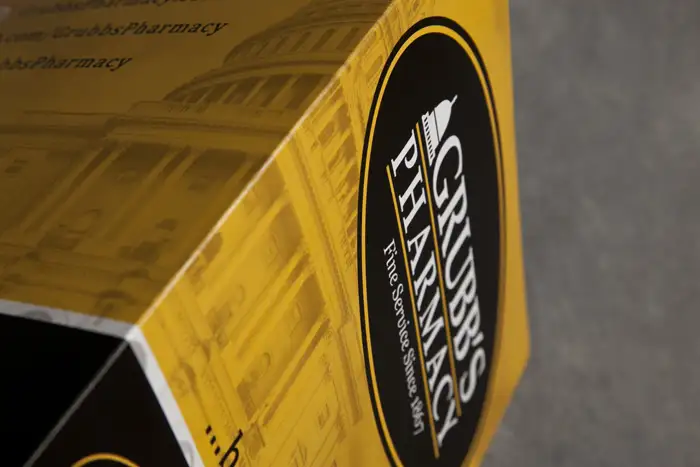
Finishing layers change that behavior. Heavy ink coverage across the spine can increase cracking. A foil-stamped logo too close to a diecut edge can distort under pressure. A coated or laminated glue flap may not bond unless the construction accounts for it. Finishing choices can affect performance as much as appearance.
Starting With the Surface
The first finishing decision often matters most because it affects how the sheet can be sealed.
Liquid Coatings
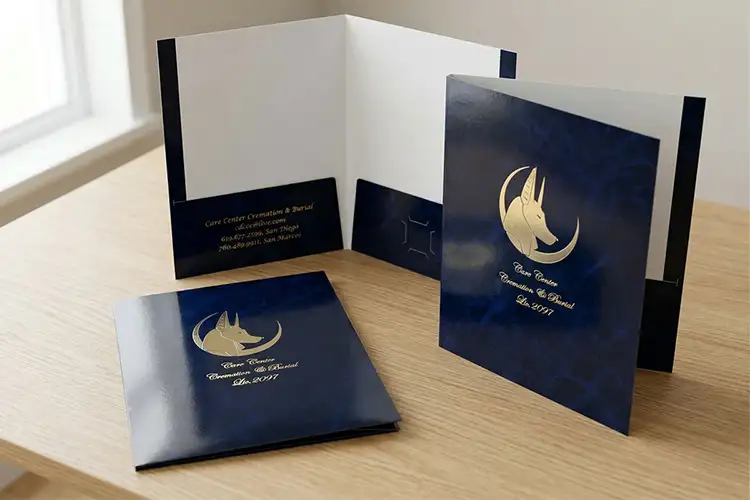
Aqueous and UV coatings are liquid-applied polymers cured by heat or ultraviolet light. In flood coats, they provide scuff resistance but do not add structural support like film lamination. At score lines, they usually lack the flexibility to move with the paper fibers during folding. On dark, high-coverage areas, that can lead to cracking and ink flaking that exposes the white stock underneath.
Film Lamination
Film lamination adds a protective layer that helps folders hold up better at the spine and pocket folds and makes visible cracking less likely.
- Gloss lamination: Offers the most visual pop. Adds shine, boosts contrast and improves scuff resistance.
- Matte lamination: Offers the most understated finish. Reduces glare and creates a quieter, more refined surface.
- Soft-Touch lamination: Offers the strongest tactile appeal. Adds a velvety feel and a more premium tactile effect.
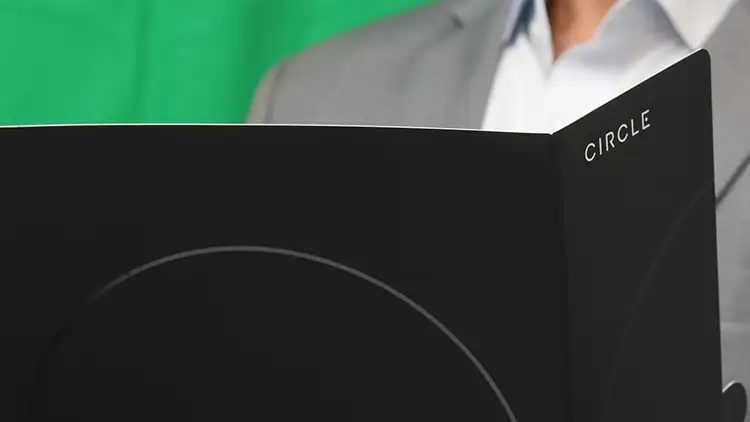
When a design uses heavy black, navy or other dense solid across the spine, film lamination usually is the safer choice. Matte and soft-touch films often are preferred because they help bridge the fibers at the score and hide fold stress better than gloss.
Glue Areas and Knockouts
Glue poses several production challenges. If flood UV or film lamination covers the pocket glue areas, the adhesive cannot bond to the paper fibers properly. This can cause the folders to pop open during finishing or after delivery. Glue-area knockouts need to be planned in advance. In more advanced workflows, selective lamination or bondable films can solve the problem, but those choices need to be made in prepress and estimating, not after press.
Foil Stamping and Surface Performance
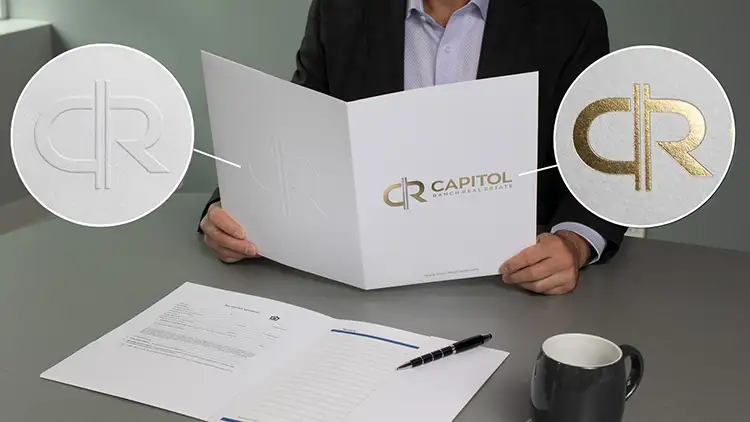
Foil stamping remains a strong choice for presentation folders because it delivers full opacity, sharp contrast and reflective impact that process inks and many metallic inks often cannot match.
Results depend on heat, pressure, dwell time and die material. Magnesium dies often are the economical option for short runs and simple graphics. Copper holds heat better and supports cleaner detail in medium runs. Brass typically is preferred for long runs, fine detail and combination work, such as foil with embossing.
Foil only is as reliable as the stock beneath it. Some coatings and laminates accept foil well. Others do not. High-slip aqueous coatings, especially silicone-heavy ones, can be problematic. Coating, laminate, foil and adhesive choices need to be considered as one system rather than separate add-ons.
Embossing, Debossing and Stock Response
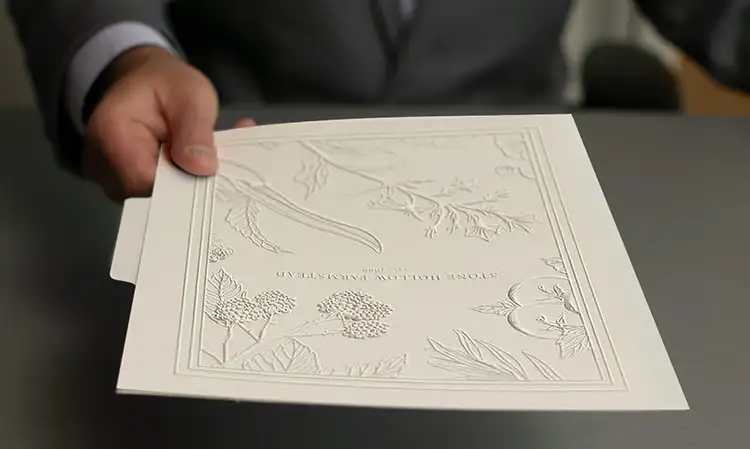
Embossing and debossing create relief effects by reshaping the stock with matched dies. The result is refined, but it comes with structural trade-offs.
Memory of Paper
Deep embossing changes the memory of the paper. If it sits too close to a score, the folder may bow, resist closing or refuse to lie flat. On recycled stocks, it also can cause feathering or micro-cracking around the image edges. The deeper the relief, the more important stock selection and placement become.
The Bruise
Embossing is a two-sided process, so the reverse image will show inside the folder or pocket. If that interior panel needs to stay free of visible “bruising” on the reverse-side, the emboss must be applied to a separate sheet and then duplex laminated. That produces a cleaner finished piece and gives the embossing a more sculptural effect.
UV Coatings and Selective Contrast
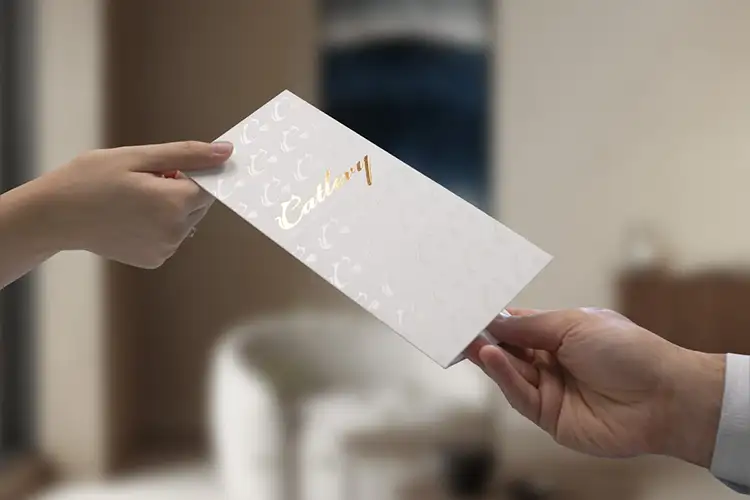
UV coatings can do a lot, but in folder design, they are most effective when used for selective gloss contrast, not overall shine. Applied selectively, they draw attention, add dimension, create visual interest and reinforce hierarchy by setting one area apart from another.
That contrast can take several forms:
- Gloss against matte: A spot UV element over a matte-laminated surface.
- Raised against flat: A textured or raised UV effect against a smooth background.
- Patterned against solid: A textured or patterned UV coating over an otherwise uniform field.
- Clear against printed: A UV-coated area standing out against a printed background without adding color.
Process Sequence Matters
Multi-finish folder work depends on process sequence.
Grain direction comes first. The grain should run parallel to the main score. If it runs short across the spine, no coating or laminate will rescue the fold. The result usually is a rough edge and a stressed hinge.
Registration comes next. When foil and embossing are combined, precision is critical. A combo die can reduce registration drift by applying both effects in one pass, but set-up still requires tight control of temperature, impression and alignment.
Surface tension also matters, especially when spot UV is applied over ink or laminate. If the surface does not wet out properly, the coating can bead instead of laying down evenly. What looks like a design issue often is a surface compatibility issue.
Finishing Compatibility in Practice
Most finishing combinations are technically possible. The real question is whether they will survive diecutting, folding, gluing, packing and normal use. Because compatibility changes with stock, coating, adhesive and process order, these should be treated as working guidelines, not fixed rules.
Standard gloss or satin aqueous coatings generally work well with embossing and basic gluing – and often, foil. Matte aqueous tends to be even more forgiving. Laminated sheets need closer attention. Gloss lamination can complicate spot UV and gluing. Soft-touch films create impactful effects under foil and embossing, but glue performance may drop unless the adhesive is chosen specifically for that surface. Heavy ink coverage also can create problems at fold lines.
Uncoated stocks handle embossing and glue well, but they are less reliable for UV effects and can be harder to foil, depending on texture and sheet formation. Compatibility is a production decision. Substrate, coating, film, adhesive and sequence all interact.
Choosing the Right Finish
The right finish depends on the job.
For high-volume utility folders, flood aqueous usually is the practical choice because it is fast, economical and adds basic surface protection with minimal complexity.
For premium pieces, soft-touch lamination with foil stamping creates stronger tactile and visual contrast that reinforces a premium presentation.
For repeated handling, film lamination typically is the safer base because it adds durability at folds and edges.
Whatever the spec, testing still matters. A simple tape test can catch foil adhesion problems before the full run.
Design for the Bindery
The best presentation folders are designed with the bindery in mind. Grain direction, glue-area voids, foil compatibility, surface tension and fold stress determine whether the folder holds up or fails in production and use.
A well-finished folder has to perform at every stress point. Folds must stay clean, glue areas must hold, the spine must resist cracking and the piece must keep its shape through repeated handling. In folder production, those details tell whether the finish was right for the job. Visual impact only works when structural integrity supports it.