


Press release submitted on behalf of IMPACK
Twenty-five years ago, IMPACK began with a problem and a young engineering student who could not stop thinking about how to solve it. This sparked a drive to ideate, innovate and create that remains an integral part of the IMPACK DNA to this day.
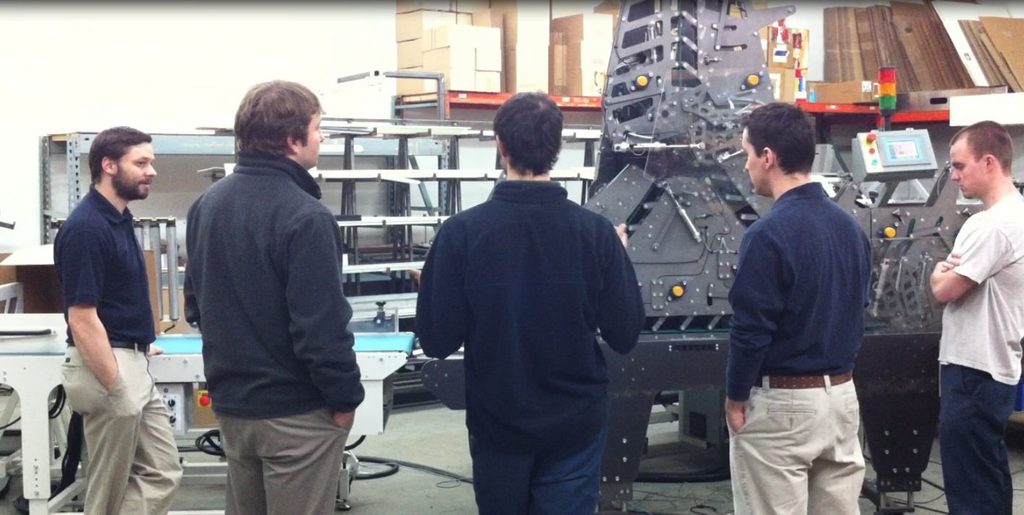
Today, IMPACK has grown into a company that designs and manufactures automation solutions for packaging producers around the world.
It started with an idea
Before there was IMPACK, there was Dominic Thériault’s instinct to create. While studying engineering and working as a consultant for a packaging company, he saw challenges in the way boxes were being packed and began sketching concepts for a better solution, even during his university classes.
Then the idea that would eventually lead to IMPACK arrived while he was driving.
“I was driving my car on the highway when I had the flash of a first machine concept. I had to pull over to draw it quickly. I didn’t want to forget it!” — Dominic Thériault, President and Founder
Dominic patented the concept and successfully proposed it to his client.
Humble Beginnings
The initial project received support from the Centre d’Entrepreneurship de l’ÉTS in Montreal (CENTECH), but the actual work began at Dominic’s home in Saint-Jacques, Quebec and in his cousin’s garage.
They had no sophisticated equipment. Dominic and his cousin made early prototypes using pieces of wood. Drills were often used as motors.
After a first round of financing, the young company moved into a former tractor repair garage in 2002. Their section did not even have a washroom—the team had to use an unheated one next door.
The limitations were significant, as was the pressure.
“We hadn’t sold anything yet. We were only developing. Establishing a new company and the cost of R&D was putting me in debt. The machine had to work. I was working long days and into the night. It was an incredible amount of pressure. I knew the solution existed, I just had to find it.” — Dominic Thériault
Dominic brought together a group of his fellow engineering students, including Mathieu Tremblay and Michel Beauséjour, who still play important roles at IMPACK
Mathieu Tremblay, now the Managing Director, remembers:
“The first years felt more like a student club than a company. We didn’t know what we were doing, but we did it with passion and determination!” — Mathieu Tremblay
The team had to learn everything from scratch; from finding suppliers and selecting components to designing machines, electrical plans and programs and understanding applicable standards.
That period laid the foundations for IMPACK’s first product lines, including the VIRTUO automatic packer, ERGOSA semi-automatic packer and MFA batch inverter.
Learning, Growing and Going Global
From the beginning, customers played an important role in IMPACK’s development. The small team would build prototypes and work with packaging producers willing to test them in real production environments. Their feedback often revealed the next challenge worth solving.
In 2005, IMPACK began developing the U.S. market. Three years later, the company installed its first machine in Europe.
A major turning point came in 2012, when IMPACK entered into an international agency partnership with a leading global equipment manufacturer.
“That partnership was decisive. It put us on the map and brought us into the big leagues.” — Mathieu Tremblay
That same year, IMPACK exhibited at Drupa for the first time. By Drupa 2016, Dominic remembers realizing the company had reached another level.
“While at Drupa In 2016, I wrote to my daughter: ‘We made it.’ Everybody was talking to us and everybody wanted to do business with us.”
The small engineering startup had become a company with a place in the global packaging industry.
Growing Without Losing the Spark
By 2026, more than 1,000 machines had been installed across 29 countries, a long way from the first prototypes built in a garage. As IMPACK grew, so did the challenge of carrying that original spirit of creativity beyond its small founding team. What began as a tight-knit group of people solving problems together gradually became a culture of innovation shared across the company.
“Without innovation, IMPACK would still be a very nice company, but it would no longer be IMPACK.” — Mathieu Tremblay
Today, dedicated teams work across engineering, manufacturing, sales, marketing, administration and customer service. Yet despite the growth, David Leblanc still recognizes the same collaborative, inventive spirit that defined IMPACK’s early years: “Even though we have a much larger team today, that spirit of camaraderie is still very much alive. Everyone is encouraged to share and challenge ideas to help improve our machines.”- David Leblanc, Director of Engineering.
And after 25 years, Dominic says the source of pride has shifted from the machines themselves to the people behind them.
“At first, we were proud of our innovations, our patents. Then we were proud of the number of machines sold and the number of countries where we had installed them. But today, it’s the team we’re most proud of.” — Dominic Thériault
Still Building
The surroundings may be very different from the former tractor garage of 2002. The motivation behind them is not. IMPACK continues to grow, develop new technologies and invest in the people who will carry the company forward.
There are still machines to improve. Problems nobody has solved quite well enough. Ideas waiting to be tested. And a team willing to ask, ‘What if we tried this?’
Dominic hopes that remains true long after the company’s 25th anniversary:
“The company was founded to realize the ideas we had in our heads. It is first and foremost a place of creation, collaboration and fulfillment.”
IMPACK has been worker-shareholder cooperative since 2005, sharing ownership and the value created by the business with employees. Today, that cooperative philosophy remains part of its long-term vision.
The company began without a factory, without much equipment and without certainty that its ideas would work. What it did have was a small group of people daring to try.
Twenty-five years later, the scale has changed.
The urge to create has not.